
Unlocked: Interview with Carin Smolinski
Doing things differently

Behind the Verticals will be back to regular programming next week. Until then, while on our summer break, we are unlocking our March 2026 interview with Carin Smolinski for you.

🎙️ Interview with Carin Smolinski
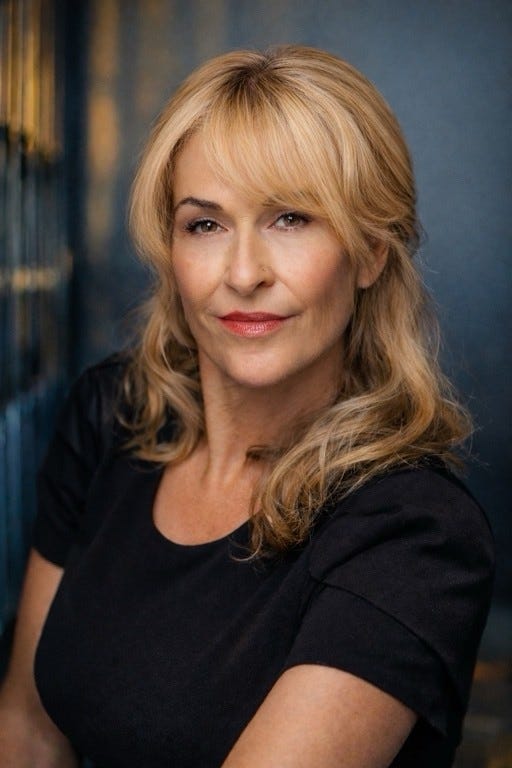
Carin didn’t come to vertical production looking for a side project. She came looking for a way to tell stories she actually wanted to watch, work alongside her son, and prove that independent creators could forge their own path in a space largely controlled by platforms. She is an actress, writer, director, and producer, often all on the same project, and she has been making verticals since before most people took the format seriously.
“Back then people really looked down on it,” she says. “But we were working. We were being paid to do the work we wanted to do and getting far bigger roles than we would have gotten anywhere else.”
That early commitment has shaped everything since.
Tides of Desire and the Costa Rica Shoot
Carin’s first vertical series, Tides of Desire, started as a small idea and grew into something much larger. She shot it in Costa Rica over ten days, working around a rainy season that brought near-monsoon conditions. The solution was a 5:30 a.m. start, a break through the hottest part of the day, and a return to set in the afternoon. Not ideal. Worth it.
The location was a deliberate choice. There had never been a tropical surf vertical before, and Carin wanted to do something different. She brought one actor from LA, kept the rest of the cast Canadian, and made a point of hiring locally in Costa Rica as well. The result was a cast with a range of skin tones, accents, and backgrounds that reflected where the story was actually set.
“Diversity is one of our key points,” she says. “And hiring locally connected us to the community instantly.”
The production was built around a different kind of set culture too. There was a cook preparing fresh food on location. A massage therapist came in for cast and crew. Boat trips through the mangroves. Surf lessons if anyone wanted them. Everyone, from the driver to the director, was treated with equal respect.
Some of this was possible because the production was independent. Some of it was just a philosophy. Either way, Carin is clear that it sets the tone.
“You have to treat people well,” she says. “And I would do it that way regardless.”
Directing While Acting
On her productions, Carin writes, directs, and acts simultaneously. The system that makes this work is built on preparation and clearly defined roles. She and her son Indiana, her director of photography, go through every shot in advance. They know the plan before they arrive on set. When she is in a scene, her first AD calls action. She calls cut. Indiana handles the technical read. She handles the performance.
When production questions come to her on set, she redirects them.
“I say, I have my director hat on right now. Please speak to the line producer.” She pauses. “You have to stay in your lane or everything falls apart.”
The producing side, she admits, is the part she likes least. The project management, the logistics, the endless coordination. But the directing and acting together she genuinely loves, because it lets her shape the whole story from the inside.
The Changemaker Argument
Carin is not subtle about what she is trying to do. She wants to forge a path for independent vertical producers, build a model where creators retain their IP, and shift the kinds of stories being told in the format. All three are connected.
Right now, roughly 70% of vertical production involves creators executing on platform-owned IP. Platforms commission, platforms own, platforms control. Carin wants to change that ratio, at least for independent producers. She has turned down low offers and deals that came with conditions she wasn’t willing to accept, not because she can afford to be cavalier about it, but because she believes the deals she accepts set a precedent for the people who come after her.
“I don’t want to settle,” she says, “because I want to set the bar for the people behind me.”
She is currently exploring co-premieres on multiple non-exclusive apps for Tides of Desire, rather than holding out for a single exclusive deal she now considers unrealistic. She is also developing branded content partnerships, looking for aligned sponsors who can help fund production and bring their own marketing reach to the table.
On the IP question, she is firm. Revenue share may be a pipe dream right now, she says, but that does not mean it always will be.
Stories for Women Who Are Done Being Sidelined
The through line across all of Carin’s projects is the same: mature women at the centre of the story, winning. Not as the suffering wife. Not as the villain. Not as the supporting character placed there to motivate a younger lead.
Her second project is a pilot she wrote for herself, a second-chance mature love story set on a ranch. Her third is a female ensemble she is co-developing with two other actresses under a new production banner, built around women of different ages whose stories intertwine.
“Middle-aged women are the target audience for this format,” she says. “And we want to see ourselves. Having redemptions. Coming back after bad breakups. Being strong, but also being vulnerable.”
She points to the data, or rather, the absence of it. Platform data on what audiences actually want is tightly held, often withheld entirely. But from what she sees in fan communities, the appetite for different stories is overwhelming. Viewers who have been watching verticals for a year or two are getting bored. Newcomers are turned off by the same recycled plots.
“China has already moved past that model,” she says. “I don’t understand why we’re still catching up.”
Pay, Respect, and the Canadian Actor Problem
Carin has been a vocal advocate on pay equity, and not in the abstract. She describes a recent casting notice for a supporting mother role in a vertical shooting in Vancouver. The day rate was 150 Canadian dollars. The production was flying in an LA male lead at two thousand US a day, plus accommodation.
“We are playing their mother,” she says. “And we’re being paid 150 dollars.”
She is careful to acknowledge that she is personally in a position where she does not need to accept those rates. That is exactly why she refuses them.
“The person next to me might need to pay rent,” she says. “If we all keep accepting minimum, it will never change.”
She is also paying attention to the work being done at the organizational level. The Vancouver Film & Short Series Alliance, led by Monika Dalman, Alicia Read, and Sammie Asteneh, has worked to establish a union vertical contract in British Columbia, a first globally. Uptake among productions has been slow so far, but Carin sees the effort as essential. There is also movement on tax credits, with the Alliance pushing government bodies to allow productions to pool credits across multiple projects, which would bring more independent vertical work above the minimum threshold and bring more money back into Canadian content.
What She Is Building Toward
Carin is fifty-three. Her youngest son is heading to university. She is developing her US presence, working on three productions simultaneously, and has just been nominated as a finalist for Best Matriarch at a vertical drama awards competition with voters across a hundred countries.
She is not slowing down. She is just getting started on the part she actually cares about.
“I get to play dress-up and make-believe,” she says. “I get to be on camera. I get to work with my son. I’m not going to apologize for loving that.”
The vertical space, for all its frustrations, is still the place she wants to be. Not because it is perfect, but because it is new enough that the rules are still being written. And Carin intends to help write them.